Castalian Order office-service rule
The Glass Bead GameThe Castalian Order office-service rule holds that appointment to higher office increases a member’s obligations: authority means stricter service, not greater freedom or self-will. First presented to Joseph Knecht during his initiation, the rule becomes a standard against which he judges both his own responsibilities and Castalia’s growing detachment from the society that supports it. Its meaning extends from institutional hierarchy to public duty and, in the rainmaker story, to the cost of serving a community in crisis.
The rule in the initiation ceremony
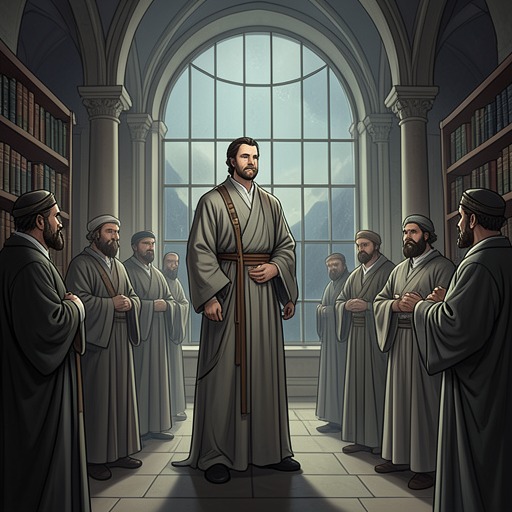
During Joseph Knecht’s admission to the Order, the former Music Master gave him a paragraph from the statutes as a subject for meditation. The passage states that an appointment from the high Authority is a step into bondage rather than freedom: the higher the office, the tighter that bondage; the greater its power, the stricter its service; and the stronger the officeholder’s personality, the less room there is for self-will. The rule makes hierarchy an obligation, not a privilege to be enjoyed for its own sake.
The ceremony gives that principle a personal setting. In the Music Master’s cell—the same room where Knecht had first been introduced to meditation—Knecht played a chorale prelude by Bach, heard the Order’s rules read aloud, and took his oath. The Music Master then told him that it was fitting for Knecht to step into the breach as he himself departed, as though a son would stand in his place. His counsel joins succession to service: taking another’s office means accepting its burdens, not merely inheriting its authority.
Public service and Castalia’s obligations
The rule’s ethical force becomes clearer as Knecht examines the relation between Castalia and the country beyond it. After his first difficult year as Magister Ludi, he resumes historical study and concludes that the reciprocal connection between the Province and the nation has been weakening for decades. The country still consults the educational authorities and receives teachers from Castalia, but such exchanges have become routine; fewer Castalians volunteer for teaching assignments outside the Province, and people beyond it turn less often to Castalia for advice.
Knecht sees a widening gap between Castalia’s specialized intellectual culture and the life of the country. As Castalian learning becomes more cultivated and self-contained, the outside world increasingly treats the Province as a precious but dispensable antique rather than a necessity. This diagnosis makes the office-service rule institutional as well as personal: a community entrusted with exceptional resources must answer to those who sustain it.
In his circular letter, Knecht argues that most Castalians obey the Order’s rules and work diligently, yet often lack insight into their place in the nation and in world history. They may cultivate scholarship for its own sake without feeling kinship with, or responsibility toward, people outside the Province. He identifies teachers serving in ordinary schools as the clearest examples of Castalia fulfilling its purpose, because their unselfish work repays the country for the education and material support Castalians receive. The intellectual foundation the Order claims to preserve depends on truth, but preserving that foundation cannot excuse indifference to the wider world.
Fragile privilege and resistance to self-assigned office
Knecht connects Castalia’s internal complacency to an external vulnerability. The Province depends on the nation’s willingness and ability to fund its food, libraries, schools, and archives. If war or impoverishment changes that willingness, Castalia’s protected life could end quickly; what is now regarded with pride might instead be seen as a burden or even a threat. In this argument, institutional service is reciprocal: Castalia cannot claim a special position while forgetting the society that makes that position possible.
The Glass Bead Game sharpens the danger. Knecht calls it Castalia’s own invention and most distinctive intellectual discipline, but also its most nonutilitarian and fragile possession. In a national emergency, practical subjects such as mathematics might survive because they have obvious uses, while the Game could be abolished as dispensable. The Magister Ludi, head of the discipline most remote from ordinary life, may therefore be especially able to sense how precarious Castalia’s standing has become.
Knecht’s attempt to act on his diagnosis brings him into conflict with the Order’s hierarchy. The Board rejects his request to be released from his office and transferred to a secular school system. Its reply insists that the Order cannot function if each member chooses his own place according to his assessment of his gifts. The refusal exposes a tension within the rule: office entails service, but the institution also claims the authority to determine where that service must be performed. Knecht’s petition asks whether obedience to hierarchy can remain sufficient when the institution itself is failing to meet its responsibilities.
Ritual, leadership, and sacrifice
In the rainmaker narrative, the rule’s logic appears outside Castalia’s formal offices. When the falling stars terrify the villagers, Knecht first hopes to calm them through reason and explanation, then recognizes that speech alone cannot contain their panic. He instead begins the familiar prayers used in public ceremonies of mourning and penance, clapping and bending in rhythm. Villagers join him; the tribal mother follows with small bows, and the scattered fear becomes a shared ritual. The ceremony does not alter the celestial event, but its rhythm and common form reorganize the people’s terror into communal discipline.
Later, the village’s distress deepens. Ada is gravely ill, the sacrifices and processions have failed to relieve the crisis, and Maro incites the people against the Rainmaker. Knecht knows that the tribal mother has already been pressed to demand his sacrifice. Rather than wait to be displaced, he dresses his son Turu in the ceremonial robes, presents him as his successor, and offers himself in Turu’s place. The tribal mother assents, and the sacrifice is carried out that day in a woodland clearing Knecht had designated. His final act makes service costly in the most literal sense: he accepts the community’s demand while arranging for his successor to assume the office.
Across these episodes, office is never simply a rank. The Music Master’s instruction frames authority as disciplined obligation; Knecht’s criticism asks whether Castalia serves the world that supports it; and the rainmaker story shows leadership expressed through ritual care and self-sacrifice. The rule’s ideal is therefore tested by what an officeholder does for others—and by whether the institution that assigns the office remains faithful to that purpose.